Designed a resource catalog that cut process modeling time by 92%
Designed and scaled a system for organizing business resources for enterprise teams, enabling faster, more reliable process modeling at scale.
End-to-end Product Design
Design Strategy
Product Ownership
Design System
OVERVIEW
Enterprises often face fragmented and inconsistent resource management, making it difficult to ensure traceability and alignment across complex business workflows. At Zenda, I led the design of Catalog, a core workspace that helps teams organize and tag business resources for process modeling. I turned a fragmented system into a structured, searchable tool that now powers Zenda’s generative and recommendation features.
IMPACT
Users are now able to build their first simple model in under 35 minutes, compared to the previous average of 6–8 hours. The Catalog designed to support over 50K resources.
TEAM
Executive Leadership, 2 Product Managers, 12 Engineering Leads, 30+ Developers, 5 Researchers, 6 Designers
TIMELINE
Jan 2024–Dec 2025

Designers no longer just shape interfaces, but orchestrate complex systems

Catalog: One of three foundational workspaces of the Zenda platform.
PROBLEM SPACE
Siloed systems, duplicated effort, and incomplete visibility into how work truly happens
In high-stakes enterprise environments, teams lack a structured way to model operational resources and apply them contextually across events. Their resource models are stored in disconnected systems such as static spreadsheets, siloed documents, and long email threads. This fragmentation led to duplicated data, inefficient planning, and weak alignment between strategy and execution.
Business Goal
Establish a scalable, universal source-of-truth for operational resources
User Goal
Enable users to view, manage, assign, and customize resources contextually during work modeling
Strategic context
This workspace is foundational to Zenda’s product roadmap, powering all downstream event generation and operational flows.
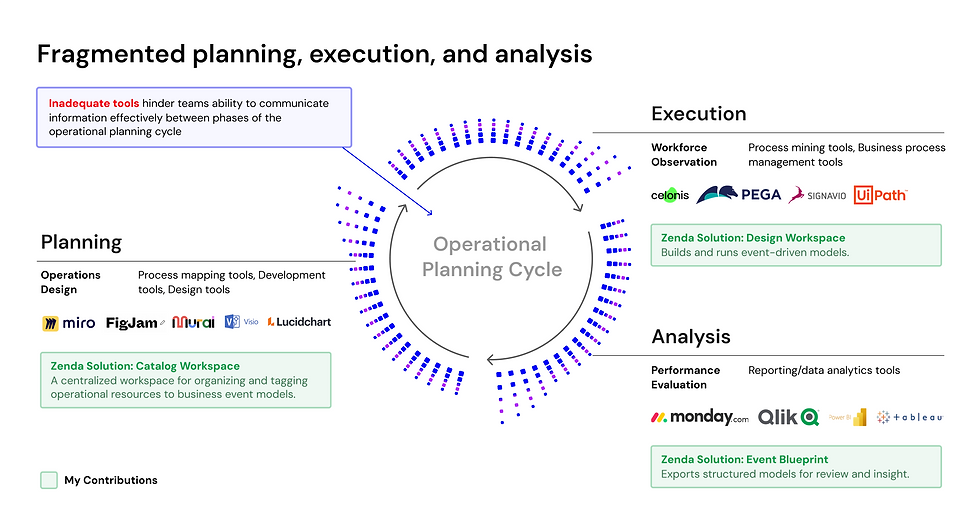
Fragmentation in the operational planning cycle and my contributions within Zenda targeted at each phase.
CONTRIBUTIONS
Blending user insights, platform constraints, and cross-functional alignment
While my primary role was Senior Designer, I routinely stepped into product and QA responsibilities to drive momentum during early platform development. I balanced long-term design vision with immediate engineering constraints, wrote user stories, scoped work, and actively participated in QA cycles to ensure the integrity of design through delivery.
Within Zenda’s workspaces, I led the design of the Catalog:

The building blocks defining the 'what' that drives the 'how' in event modeling.

The building blocks defining the 'what' that drives the 'how' in event modeling.

My Focus: The building blocks defining the 'what' that drives the 'how' in event modeling.
Contributions as Designer
Shaped the end-to-end UX from scratch by translating technical requirements into scalable, modular UI patterns grounded in user needs and system behavior.
Microinteractions & Cell Behavior

In-cell editing with support for different input types (currency, string, boolean, dropdown)

Reorderable columns with drag feedback and snap logic

Hover, focus, and truncation states for cells with limited width

Smart overlays triggered when editable fields exceed cell boundaries
Atomic Interaction Design

Cell-level behaviors: hover reveals, selected and editable states, and empty states

Mouse hotspots within header cells for resizing, reordering, and menu access

Auditing existing patterns and proposing platform-wide alignment for components
Feedback & Error States

Grouping rows dynamically based on categorical columns

Bulk upload error: in-line error surfacing and error reports

Bulk upload success: mapped row generation and auto-scroll
Design System Contributions
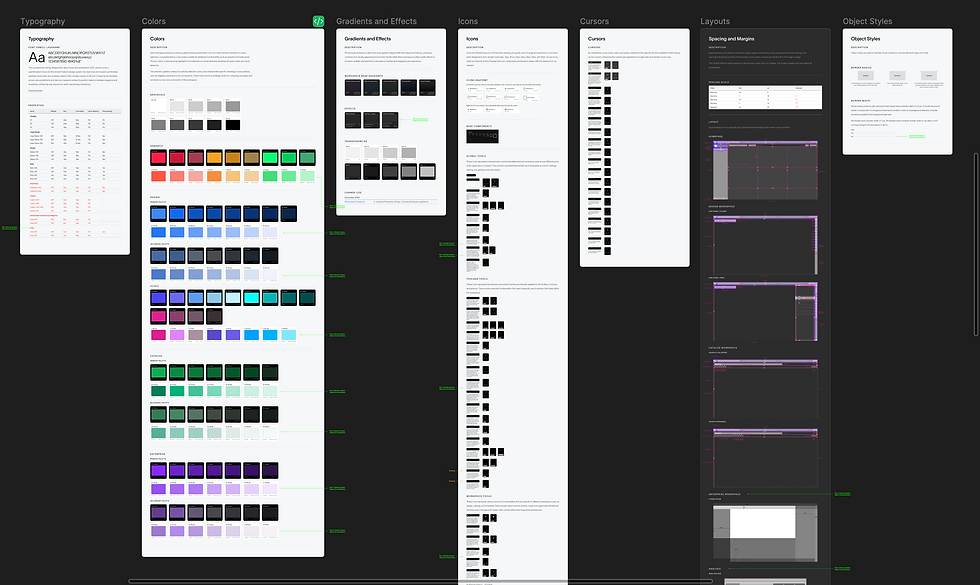
Created and formalized Zenda’s design system, including foundational styles, components, and interaction patterns

Authored specs and interactive states for global components

Documented positioning logic for context menus and right-click actions
Design Documentation

Documented the functional requirements of Catalog

Each resource type was mapped with default attributes, customizable fields, and conditional logic
Contributions as Product Owner
Partnered closely with product and engineering leads to shape backlog priorities, write user stories, and scope features. I translated design strategy into clear, actionable development plans.

Collaborated with product and engineering to define backlog structure, write detailed user stories, and set sprint priorities

Groomed epics in preparation for upcoming features on the roadmap

Facilitated ongoing backlog grooming and refinement sessions to sequence design delivery with dev feasibility

Led a data modeling workshop with Zenda’s COO, Design Director, and an external advisory board member
Contributions as QA Collaborator
Actively collaborated with engineering and QA to validate edge cases, define test coverage for complex logic, and protect the design intent through final delivery.

Partnered with QA to create test scenarios for resource-type specific validations

Manually tested edge cases in nested resource configurations, catching issues tied to duplication, field persistence, and load states

Reviewed builds in staging and provided annotated feedback on alignment, interaction bugs, and conditional logic inconsistencies

Iterated designs post-QA by refining error handling, validation cues, and fallback behaviors based on real implementation feedback
DESIGN APPROACH
Balance enterprise-level complexity with a sense of clarity and control
Translating this ambitious product vision into an intuitive, high-performance platform required solving multiple layered design problems. My focus has centered on three principles:

Clarity
-
Principle: Every resource should be immediately understandable in context.
-
Goal: Designed inline previews, role-specific tagging, and schema-aware templates to reduce ambiguity and improve navigation.

Modularity
-
Principle: Resource types should be configurable but not fragile.
-
Outcome: Created a system of type-based behaviors and attribute groups, allowing resources to flex with user needs while retaining a coherent data model.

Scalability
-
Principle: The Catalog must handle thousands of resources without degrading usability.
-
Outcome: Partnered with engineering to introduce lazy loading, search filters, and progressive disclosure UI that kept performance tight and workflows manageable at scale.

Evolved the Catalog interface from static tables to a modular, type-aware UI.

Schema-aware fields (e.g., RACI only for Roles) are dynamically shown when resources are applied to events.

Personalization features such as search filters and sort reorders help users navigate large datasets.

Lazy loading designed for users managing catalogs with 50K+ resources for performance optimization.
DESIGNING WITH CONSTRAINTS
Real-world Constraint → Strategic Pivot
While designing the Catalog’s sort feature, I initially proposed dynamic sorting to support real-time, personalized table interactions. But with infinite scroll and batched loading, a critical issue emerged: edited rows were duplicated across scroll positions, causing unsynced updates and data integrity issues.
Intended Interaction

Original plan: dynamic sorting repositions rows in real-time to support personalized, real-time table interactions across large datasets.
Real-World Constraint

Infinite scroll introduced a critical sync issue: mirrored rows caused data inconsistency and a fractured user experience.
Final Shipped Design

Pivoted to static sorting: prioritized predictability and system stability while preserving user expectations.
With implementation about to begin, I made the following key decisions:
-
Initiated a rapid alignment across design, product, and engineering to assess backend and interaction limitations.
-
Pivoted from real-time row reordering to static sorting to eliminate mirrored rows and ensure a predictable user experience.
-
Preserved global sort state across all loaded batches, even when users scrolled or paged through the table.
-
Ensured edits could be made without triggering unintended reshuffling, reducing disorientation in long-form modeling workflows.
-
Documented sorting logic for edge cases including blank values, tie-breaker behavior, and float/boolean fields to create parity across resource types.
What I learned:
Designing within system constraints is not about compromise, it's about making smart, scalable decisions. This moment sharpened my product judgment and reinforced the value of cross-functional clarity during critical pivots.
OUTCOME
A Scalable System for Resource Modeling
Commercially available since June 2025, kickstarting with licenses/intent to license within the following industries,
-
Finance & Banking
-
Consulting & Professional Services
-
Legal Services
-
Healthcare & Supply Chain
-
Real Estate & Construction
50K
Resources supported with flexible field control and access logic
ZERO
Learning curve to build first basic model and create resources from scratch
Business Impact
-
I partnered with product and data teams to establish the Catalog as the single source of truth for operational resources.
-
Minimized duplication, reduced planning friction, and improved alignment between systems of strategy and execution.
Human Impact
-
Users can model processes without constant tab-switching.
-
Contextual previews, type-specific logic (e.g. RACI for Roles), and auto-filtered fields help people navigate complexity with ease.
Technology Impact
-
The system informed modular backend schemas and API strategies.
-
Supports dynamic field rendering and tight integration with modeling flows, enabling real-time extensibility.
Data Impact
-
Each catalog element is now a normalized, type-safe record. This allows for traceability, versioning, and insights.
-
Setting the foundation for pattern recognition, compliance checks, and future AI tooling.
Impact
Reflection
As the product matured, I moved from establishing UI foundations to owning platform-wide decisions. I led cross-team reviews, managed high-pressure pivots, and mentored other designers into the system.
Designing the Catalog Workspace has also been an exercise in structuring complexity without stripping away nuance. Behind every role, tool, or policy was someone trying to make sense of their organization. My aim wasn’t to design forms, but to create a flexible language teams could use to reason through complexity, together.
With the foundation now in place, I'm currently exploring:
-
Relationship visualization across catalog elements
-
AI-assisted modeling and pattern detection
-
Enterprise trees as organizational blueprints of work

Workshop using folded paper to model data aggregation and nesting.
Shout-Outs from the Team
Varnika - During your team’s demo you did something that I wanted you to know didn’t go unnoticed. While one of the developers was presenting, he was getting a bit of heat about certain aspects of his work - all justified criticisms. However, you took a second to congratulate that person on all the good work… while not diminishing or defending the criticism. That comment went a long way to encourage that developer, and you didn’t risk appearing defensive. Well done!
Harold Hambrose
Chief Strategy Officer, ZENDA
Besides providing detailed designs and test cases with almost no questions left unasked, Varnika has been an awesome QA, catching up and always asking about scenarios that no one else considered and solving any product questions that come up.
Diogo Brito
Principal Engineer, Nagarro
Varnika is a great addition to any design team. With a sharp eye for detail and well placed insights, she is a valuable asset at design critiques. Her open and available approach to brainstorming and solutioning complex problems makes her a super dependable and helpful colleague on the design team at Zenda.
Aishwarya Rane
Senior Designer, ZENDA