Designed an AI-powered audio editor that cut podcast editing time by 89%
Reimagining a digital audio workstation for a broad range of users, including podcasters, educators, and storytellers who aren’t necessarily audio experts.
Mobile & Web-App Design
Interaction Design
Visual Identity
Rapid Prototyping
OVERVIEW
In 2020, as podcasting and remote content creation surged, traditional audio tools remained complex and slow, creating barriers for a new wave of storytellers. I redesigned the Koolio app, turning a technical proof of concept into a polished, intuitive product. The goal was to bridge backend AI intelligence with frontend usability, making advanced audio workflows fast, collaborative, and accessible to users of all skill levels.
IMPACT
Drove Koolio’s product-market readiness with intuitive UX that boosted creator adoption and commercial launch.
TEAM
Koolio.ai Founder, Audio SME, Product Owner, and Engineering Team
TIMELINE
May 2020–Jun 2020

Timeline of the project, highlighting how strategy and execution evolved in parallel.

Koolio’s web-based Digital Audio Workstation
CHALLENGE
Technical POC with low usability and unclear collaborative mechanics
-
The AI engine was strong, but the platform offered little visibility or control over its process.
-
Visual hierarchy was unclear, with scattered controls and weak navigation logic.
-
No integrated way for teams to work together in real time.

Before: Poor organization of controls and editing tools
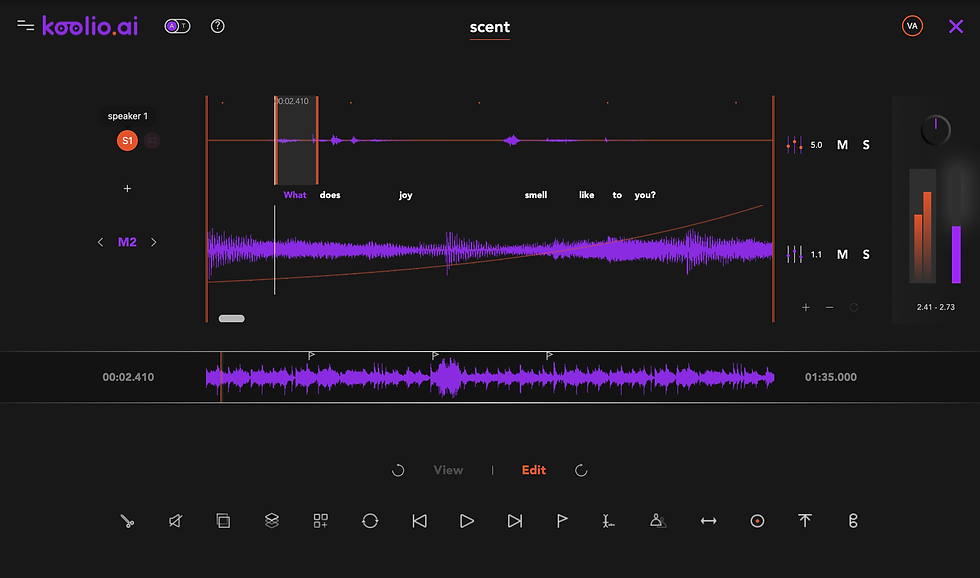
After: Improved discoverability of key features like sound effects and audio manipulation

Before: Word cloud visually engaging but lacked interactive function

After: Integrated transcript-driven editing and contextual keyword highlight

Before: Basic, non-editable audio controls

After: Expanded and structured controls, separated into viewing and editing modes
DESIGN PROCESS
Integrating AI as a creative partner, not just a backend feature.
As I set out to redesign Koolio, I saw a clear gap in the audio editing space. Descript was intuitive, Audacity was flexible, and Audition offered pro-level precision, but none combined ease, accuracy, AI, and collaboration. I designed Koolio to close that gap and reimagine the creative workflow for modern audio teams.

Benchmarking competitors to identify gaps in visual and interaction design, AI intelligence, and collaboration features.
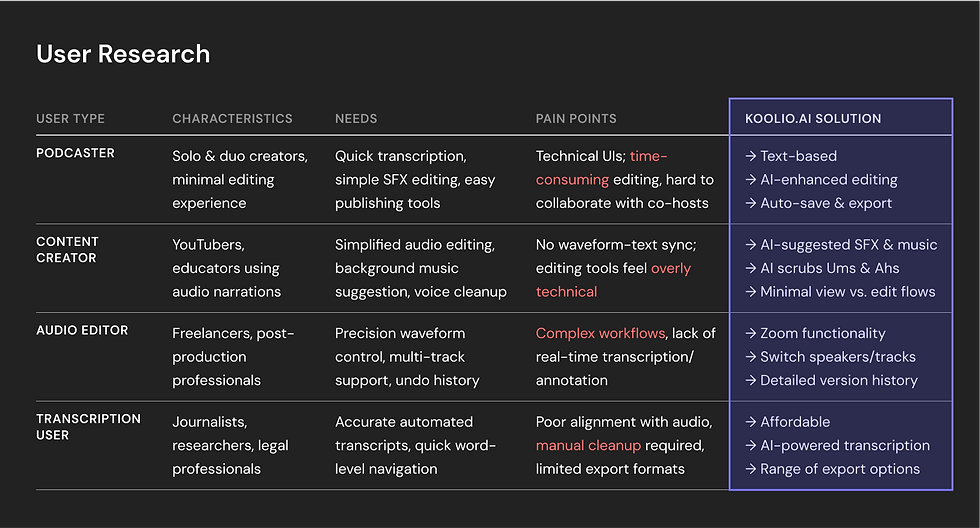
To position Koolio.ai, I mapped out core user needs.

Assessed and reorganized key features to improve usability and visual hierarchy.

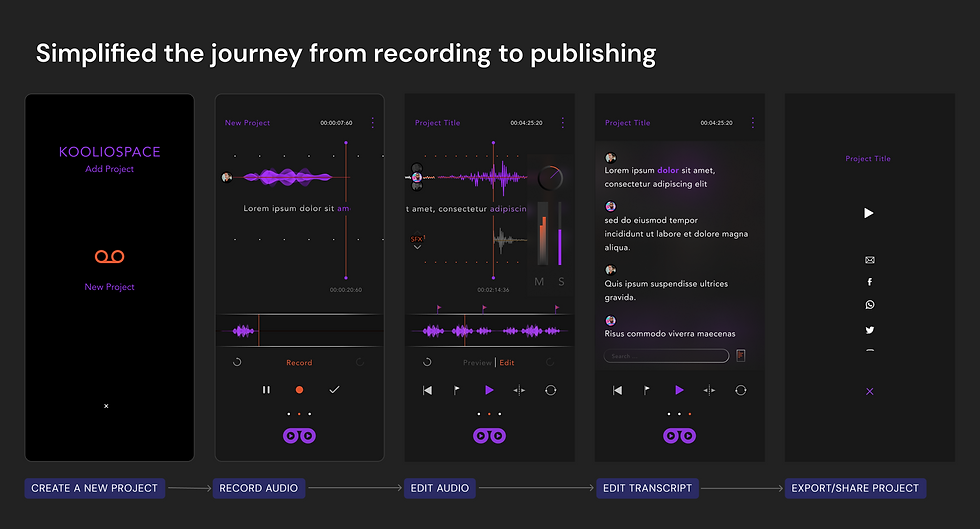
Designing user journey with insights from SME
DESIGN APPROACH
User-Centric Simplicity
I transformed the product into a responsive, intuitive web-based DAW by redesigning both the information architecture and visual language, grounded in the needs of fast-moving creators.
Audio-Text Symbiosis
-
Principle: Treat transcript and waveform as one system.
-
Outcome: Waveform edits reflect text changes in real-time, and vice versa. The symbiotic interaction model reduces redundancy and error.
Visual Identity Refresh
-
Principle: Design should reflect voice, clarity, and intelligence.
-
Outcome: Koolio’s rebrand introduced a more confident, contemporary look to align with its AI-powered creative mission.
Transparency in AI
-
Principle: Let users trust and understand AI decisions.
-
Outcome: Build trust in automation while preserving creative agency by giving the user the final say.


<30 min
To publish from raw recording to distribution-ready content
4.0✰
From 1,990+ users with 57% rewarding a perfect 5-star rating
Business Impact
-
A more usable product supported early adoption and positioned Koolio for commercial growth.
-
By simplifying workflows, Koolio could tap into a broader, non-technical user base including educators, marketers, and content creators.
Human Impact
-
Made professional audio creation accessible to users with no background in sound engineering.
-
Reduced cognitive load with clear hierarchy and simplified workflows that let users focus on storytelling, not tools.
Technology Impact
-
I helped translate a robust AI infrastructure into a usable, intuitive frontend.
-
Delivered DAW-level functionality fully in-browser, enabling wider access across devices.
Data Impact
-
Editable transcripts helped users interact with AI-generated content in meaningful, traceable ways.
-
By balancing transparency and automation, the redesign gave users control without overwhelming them with technical detail.
Impact
Reflection

First Figma prototype in 2020
This was one of my first UX design projects, where I quickly taught myself Figma while transitioning from Adobe XD. Since then, I have grown significantly, especially in mastering components for prototyping and creating reusable design systems.
The project itself was a true sprint focused on speed and close collaboration. It taught me how to translate a technically impressive backend into an interface that supports human creativity. Above all, it reinforced that the best design is invisible, allowing creators to focus on creating, collaborating, and publishing without friction or barriers.